
Dancers obviously communicate through their body. But what is the connection between dance, and how we communicate through words?
I train regularly with Melbourne Contact Improvisation dance teachers, Emily Bowman and Joey Lehrer. Movement has always been critical to my work as a speaker coach, and a specific exercise they included in their last training has helped me better articulate the impact of embodied movement on verbal communication.
The people you meet in any training course – be that dance or leadership and strategy – can be as valuable as the content. You might find professional contacts, new friends or a community. Often, you meet by making eye contact and shaking hands or saying hello.
In Contact Improvisation your first “meeting” with someone may be through touch.
Pioneered in the 1970s by Steve Paxton and Nancy Stark-Smith, the Contact Improv dance form (CI) uses a rolling point of contact and shared weight to guide movement. The right physics allow two or more dancers to move fluidly together, sometimes slowly; other times almost effortlessly lifting each other.
In a five-day workshop, Emily and Joey gave each participant 3 minutes to talk to the other dancers about whatever they wished. Inspired by an exercise at Freiburg Contact Festival Teachers Exchange, they called it a 6×3: 6 speakers with 3 minutes each to speak. We did one 6×3 each day after lunch.
You may have experienced a similar exercise at leadership training; often done in pairs or small groups, each person has an allotted amount of time to speak freely, without interruption. The practice invites listening, being heard and knowing your peers.
Seeing this listening activity as part of contact improvisation training dance revealed another layer.
By the time each dancer spoke, they had spent several hours – or several days – dancing.
We might say they were, “embodied”.
Pause now, as you read, to notice what you think, or feel, when you hear the word “embodied”.
Perhaps you recall a taste of “being embodied” after yoga class, swimming in the sea, or playing rugby. You are aware of your body and its sensations; possibly with a quieter mind than usual.
Most CI workshops give attention to the nuance of attention. We are aware, for example, of individual ribs as we roll our torso across the floor; a slight tilt of the head leads the body into a fall and lift; we sense a shift in the balance point of a partner’s sit bones as they roll across our back.
The “embodied-ness” of speakers in this 6×3 exercise was granular.
When they spoke we could see the nuance of this granular embodiment.
I don’t think we can separate embodiment from language and strategy. The three work together.
Drawing on practices like CI, I help speakers learn to read the audience and develop, in “complicité” (a connection with audience and co-presenters), a vision for a future that starts now. Some organisations separate embodiment from the way we talk and their strategy. Sometimes they ignore one completely. My work examines how holding all three allows something to be made possible, for the speaker, audience and idea.
When speakers begin working with me, many think about their body, but not being in their body per se.
“What do I do with my hands?” they ask.
Rather than, say, “How do I be with my hands?”
What’s interesting, is that, when you are “in your body”, your arms usually do something quite natural and watchable.
While a ballet dancer may strive for an ideal form, contemporary dancers let their individuality shine through. That’s what we want in speakers too.
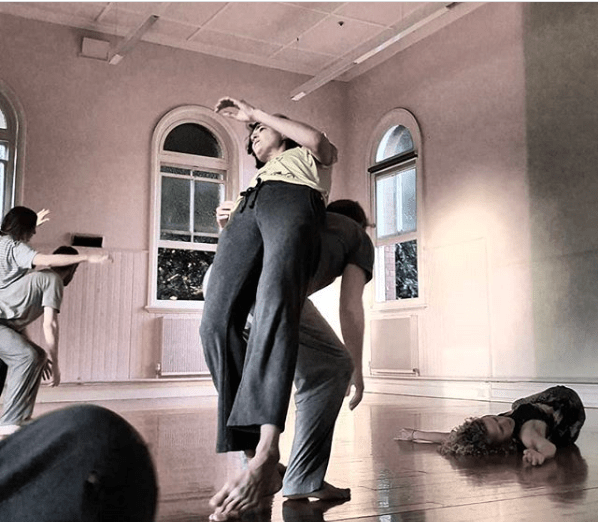
Embodiment doesn’t magically happen with a quick power pose.
It’s a lifetime of work. Explored appropriately, as your embodiment practice develops, so too should your (embodied) language and strategy. [Stay tuned to this blog for more on that!]
Many people don’t even realise they are allowed to be in their body when they speak.
When each speaker took their 3 minutes to talk, something magical happened.
They were all marvellous.
We saw them.
We saw what they thought through their body.
To someone who has closely watched many, many speakers, seeing 24 unique presenters all light up – and coherent, fluid and engaging – is a gift.
Many were self-confessed introverts
These 24 people weren’t beautiful to watch because we had a room of 24 extroverted performers. Many said they were terrified. Two had only recently started Contact Improvisation.
The way you move imprints itself in your posture, your facial expressions and your tone of voice. Your movement practice affects how you perceive yourself when you are on stage, and how you perceive your listening audience.
When we hear words that come from a place of embodiment, it’s powerful. When we hold embodied language together with strategic intent we have a speaker who pulls an idea forward into the world.
Rachael West is a strategic speaker coach interested in the link between how we move, how we think and what our ideas do once we share them with the world.

 STRATEGIC SPEAKER COACH RACHAEL WEST