
Rachael, I have a wild idea for my next talk. Do you think I’m mad?
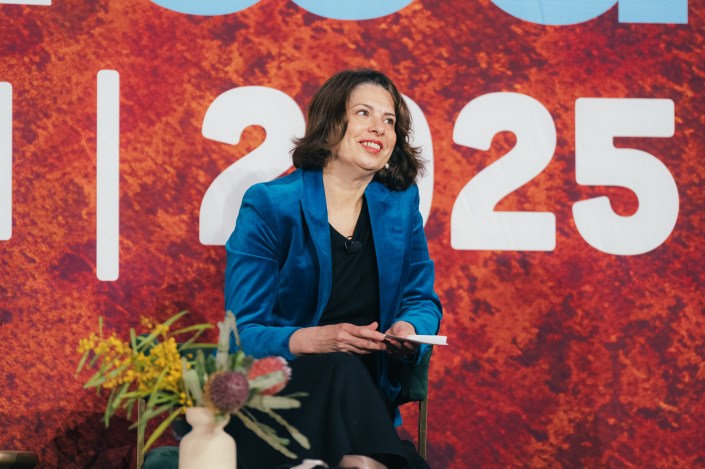
Speaker: Megan McCracken
Role: Executive Coach & Non-Executive Director
Genres: Conferences, workshops and in conversations with authors
Challenge: Do something wild for her next corporate talk
Event: WIMWA Annual Summit, Perth Convention Centre
Audience: 1200
Time: 15 minutes
A client I first worked with a decade ago came to me with an exciting request. “Rachael, I have a wild idea for my next talk. Can you help me?”
Over the ten years since I first coached Megan McCracken, she has become a respected, warm and informed public speaker. Megan speaks at conferences, run workshops and in conversations with authors, at bookshops and writers festivals.
For her next talk at WIMWA 2025, a major industry event with an audience of over 1000, Megan wanted to do something different. She approached me for Strategic Speaker Coaching.
How Megan challenged herself as a speaker
Megan was writing a talk about AI and what it means to feel human. As an executive coach, she had been asking her clients a question: “What would you bring back to your life that has been streamlined out of it?” Megan told me that every single time the person would get really animated. “I needed an hour to hear them out”, she said.
AI and being human was a perfect fit for the summit’s theme and Megan felt a strong sense that the timing was right.
Megan brought three key challenges to our speaker coaching work together:
- Incorporate physical theatre, including an outfit change. Physical theatre, including props and movement can enhance a keynote when used seamlessly. Make sure it supports your message rather than distracting.
- Communicate a complex topic that is still being formulated. Hearing a speaker’s new ideas can energise and excite an audience, as long as it doesn’t feel like you are processing the idea in front of them.
- Prepare it all in just two weeks. I usually recommend 6-12 weeks to prepare a significant talk. However, a tight timeline can help focus – if you have the time to give.
Key speaker coaching moments
I began the speaker coaching process with a Landscape Scan, which can speed up the process of developing a keynote and provide a richer experience for speaker and audience.
In the Landscape Scan I help speakers consider many angles and perspectives before their writing begins. In Megan’s case, the Landscape Scan included uncovering – and feeling – her intent for this presentation.
The Landscape Scan also considered what this talk meant for Megan within her evolution as a coach. We found that Megan wasn’t just bringing a new topic to the stage, the talk marked a shift in her professional approach to executive coaching.
The shift was an exciting one, expanding what Megan could offer future clients. However, she was concerned for existing clients in the audience. Might they be confused if the Megan they saw on stage was not the Megan they were used to?
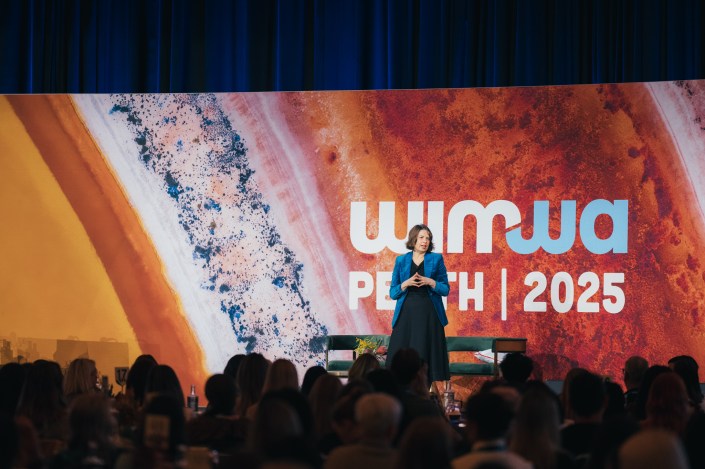
To help with this conundrum, I proposed Megan take her audience on two journeys: the first being the topic narrative, and the second something I call the Undercurrent. The Undercurrent is something an audience senses, although it may not be named explictly by the speaker.
Megan’s topic narrative was the story of AI and humanness and her Undercurrent would be her growth and development as an executive coach.
Embodiment as a public speaker
When we started work on Megan’s delivery, I considered the physical and “embodied” elements that would help Megan’s narratives land with (or make sense to) her listeners.
One layer of embodiment was guiding Megan to notice the different parts of her that appeared throughout her talk. The parts included Familiar Coach Megan, Emerging Coach Megan, and a Frazzled Technology Part that was core to her topic. We looked at the ways those parts move, think and relate to the audience.
Embodiment – paying attention to feelings and movements – gave Megan the tools to bring her subtle but distinct characters to life over her 15 minutes on stage. This led to a rich and interesting journey for her audience.
Megan’s use of props, movement and costume change was a great opportunity to enhance her stage presence. Rather than using them simply for theatre, I showed Megan how different postures and objects – and even where she placed her notes – could signpost her stage personas and add to her message, rather than distract.
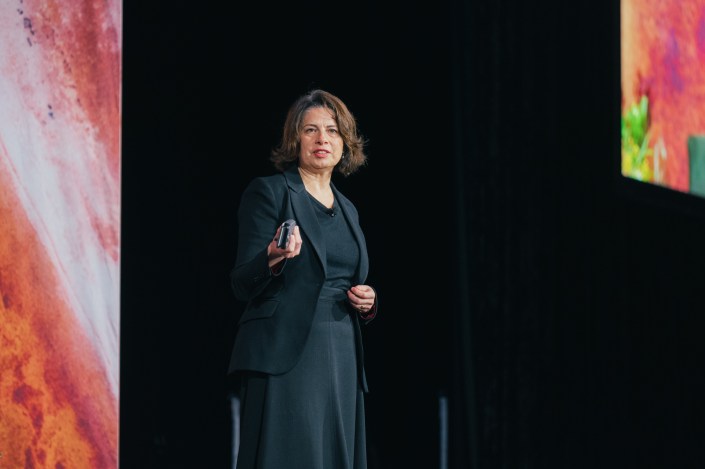
Embodiment also helped Megan to notice when she would shift into “convincing” mode. When an idea is new or uncertain, speakers can fall into the habit of talking “at” an audience. Keynote speakers generally do all of the talking, speeches are more effective if you are able to listen and respond to the room.
Megan’s impact as a speaker
Megan was already a skilled speaker, but by challenging her approach to include physical theatre and a still forming, complex topic, she was able to bring something new to the stage. Audience members said Megan made them think about their relationship with themselves and with tech. They laughed; some got teary. The audience was with Megan for every word (and costume change). Importantly, Megan started a conversation. This type of delivery – connected, co-created, curious – is generative over time, propelling the speaker, their idea and their audience.
“You helped me to craft this for the stage, and to build in creative and physical elements in a way that added to, rather than detracted from, my message. You challenged me as a public speaker and I felt really supported in that”.
(Megan McCracken, 2025)
Rachael West has been a Strategic Speaker Coach for over 15 years. She draws on a rich background in innovation and strategy, plus training in physical theatre, Body Mind Centering and other movement and performance practices to help speakers of all levels deliver great talks that make their ideas ripple. Contact Rachael to discuss how her speaker coaching can transform your next talk.

 STRATEGIC SPEAKER COACH RACHAEL WEST